

The ROI of Home Window Tinting: How Much Can You Really Save During Winter?
Table of Contents
ToggleWinter exposes weak spots fast. Glass feels cold, rooms near large windows drift cooler, and the thermostat inches up. Window film is often sold as a summer upgrade, yet homeowners who ask about the ROI of residential window tinting usually want results in every season. In winter, energy efficient window tinting can help by reducing radiant heat loss at the glass and improving comfort where untreated windows feel harsh.
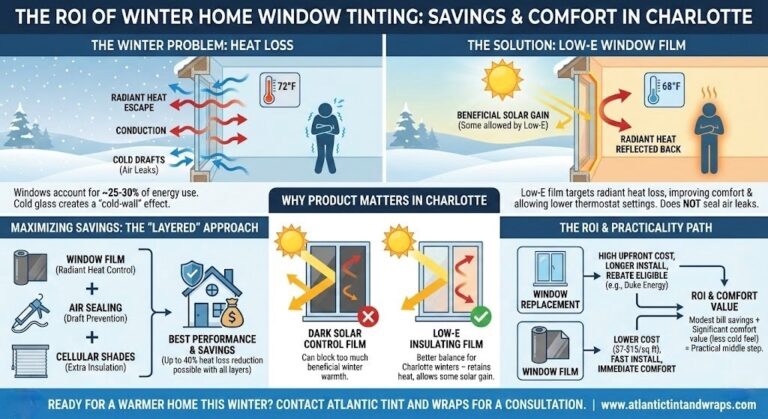
Windows deserve attention because they influence a big share of HVAC demand. The U.S. Department of Energy estimates that heat gain and heat loss through windows account for about 25% to 30% of residential heating and cooling energy use. That number blends heating and cooling, but it highlights why window upgrades can move the needle.
What window film does, and what it doesn’t
Heat escapes through windows by conduction through the window system, radiation from warm interiors toward cold glass, and air leakage around frames and sashes. Film mainly tackles radiation. It won’t seal gaps, so drafts require weatherstripping, caulk, or window repairs.
The Goodness of Low-E Window Film in Charlotte NC
Low-emissivity films target the radiant pathway. DOE notes that films with low-e coatings can reduce winter heat loss and increase thermal comfort. A warmer interior glass surface reduces the cold-wall effect, which often feels like a draft even when the air is still.
Product selection matters in North Carolina. Films designed for strong solar control can cut summer heat gain but may also reduce the sun’s helpful warmth in winter.
Lower SHGC reduces solar transmission, which is useful for cooling, but it also reduces beneficial winter gains. For many Charlotte-area homes, an insulating low-e film (rather than a dark, highly reflective solar-control film) is the better winter match.
What You’ll Spend and What You Might Get Back
Cost sets the starting line. Recent pricing figures place professional residential window tinting around $7 to $15 per square foot, depending on film type and window complexity.
Winter savings vary with the windows you already have. Older clear glass tends to show more improvement than newer factory low-e glass. A grounded way to estimate savings is to total your winter utility costs, then assume only a small, repeatable percentage change.
If the savings feel modest, remember that comfort has value too: when the glass feels less cold, many households hold a slightly lower thermostat setting without noticing.
Thermal Window Insulation for More Savings
Film performs better when you pair it with basic building-envelope work. Air sealing reduces the draft pathway directly. Interior coverings can help as well. DOE reports that tightly installed cellular shades can reduce heat loss through windows by 40% or more, which equates to about 10% heating energy savings in some cases. Film plus sealing plus an insulating shade can outperform any single measure used alone.
Charlotte Home Improvement Rebates: The Shortcut to Faster Payback
Incentives can change the math, especially if you’re comparing film with replacement windows.
Duke Energy’s Home Energy Improvement program advertises window replacement rebates that can reach $4 per square foot of qualifying window area (up to a cap). Those rebates generally apply to qualified replacement windows, not retrofit film, so treat film as a separate option with a lower upfront cost.
For a broader scan of programs, DSIRE tracks energy incentives and is operated by the N.C. Clean Energy Technology Center at N.C. State University.
Install Window Films Today
For many homeowners, film is a practical middle step: less expensive than replacement, faster to install, and capable of improving winter comfort right away. If you’re in the Charlotte area, Atlantic Tint and Wraps can help confirm glazing compatibility and select a film that fits how your home actually gets sun.
Frequently Asked Questions
- Does home window tinting keep heat in during winter?
Low-e films reflect some indoor radiant heat back into the room, keeping the glass warmer, especially at night and early morning. Pair film with weatherstripping and caulk, since air leaks around frames still waste heat.
- How much can I save on heating bills with window film in Charlotte?
Heating savings in Charlotte are usually modest. Homes with older clear glass and large window areas tend to see more change. Homes with newer low-e windows often see less.
- Is window tinting cheaper than window replacement for energy efficiency?
Usually. Residential window tinting costs far less than replacing multiple windows. In fact, DOE lists retrofit window films as a lower-cost step to consider before full replacement.
- What is the average payback period for residential window tinting?
Often several years when you count both heating and cooling. Payback is faster with lots of untreated glass, higher energy prices, and rooms that get strong sun.
- Will window film help with drafts in my Charlotte home?
Film doesn’t seal gaps, so it won’t stop drafts. It may reduce the cold-glass feel, but weatherstripping, caulk, and window hardware repairs handle air movement.